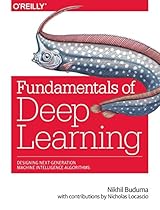
Fundamentals of Deep Learning: Designing Next-Generation Machine Intelligence Algorithms
| Author | : | |
| Rating | : | 4.66 (988 Votes) |
| Asin | : | 1491925612 |
| Format Type | : | paperback |
| Number of Pages | : | 298 Pages |
| Publish Date | : | 2016-03-10 |
| Language | : | English |

DESCRIPTION:
Amazon Customer said not a great hands-on book. Constantly assuming you have a solid background on almost all the concepts the author is trying to teach not a great hands-on book. Buy "Make Your Own Neural Network" for the first couple chapters, 1000% better explanation on both implementing neural nets and the math behind it. Disappointed.. Good book, confusing support materials consumer of goods Very good intro to the ideas behind deep learning systems. I'm a beginner in this field, I'm still only part of the way through the text but I think I'll finish it and learn a lot.One issue right now, that could be easily solved, is that that using the accompanying source code at github can be frustrating. The book itself is not clear about exactly which version of Python and TensorFlow is required to run the examples. The downloaded code I tried so far uses Python 2.x, and a much earlier version of TensorFlow than I'm using (1.2), it seems to use pre-1.0 tensorflow but I could be wrong This is not a huge problem if you ha. OK tutorial I was looking forward to this for some time, hoping it would be a clean practical description of how to implement a basic deep network. This is more of an introductory tutorial on the basics that uses the TensorFlow library for illustrations.Though this isn't what I was looking for, I assume the objective was to product a good such tutorial. But it's written in a wordy manner, spends many pages reviewing basic machine learning, non-deep networks, and misc topics like reinforcement learning, defers details of algorithms such as AdaGrad and many other things to the Tensorflow implementations, and could use more/better exampl
At age 19, he had a first author publication on using protist models for high throughput drug screening using flow cytometry. Nikhil Buduma is a computer science student at MIT with deep interests in machine learning and the biomedical sciences. Nikhil also has a passion for education, regularly writing technical posts on his blog, teaching machine learning tutorials at hackathons, and r
About the AuthorNikhil Buduma is a computer science student at MIT with deep interests in machine learning and the biomedical sciences. He is a two time gold medalist at the International Biology Olympiad, a student researcher, and a â??hacker.â? He was selected as a finalist in the 2012 International BioGENEius Challenge for his research on the pertussis vaccine, and served as the lab manager of the Veregge Lab at San Jose State University at the age of 16. Nikhil also has a passion for education, regularly w
For the rest of us, however, deep learning is still a pretty complex and difficult subject to grasp. In this practical book, author Nikhil Buduma provides examples and clear explanations to guide you through major concepts of this complicated field.Companies such as Google, Microsoft, and Facebook are actively growing in-house deep-learning teams. With the reinvigoration of neural networks in the 2000s, deep learning has become an extremely active area of research, one that’s paving the way for modern machine learning. If you’re familiar with Python, and have a background in calculus, along with a basic understanding of machine learning, this book will get you started.Examine the foundations of machine learning and neural networksLearn how to train feed-forward neural networksUse TensorFlow to implement your first neural networkManage problems that arise as you begin to make networks deeperBuild neural networks that analyze complex imagesPerform effective dimensionality reduction using autoencodersDive deep into sequence analysis to examine languageUnderstand the fundamentals of reinforcement learning